
On September 17, 2024, the day before the Federal Reserve started cutting, the top of its policy range sat at 5.50% and the ten-year Treasury yielded 3.65%. On Thursday the top of the range was 4.00% and the ten-year closed at 5.18%.
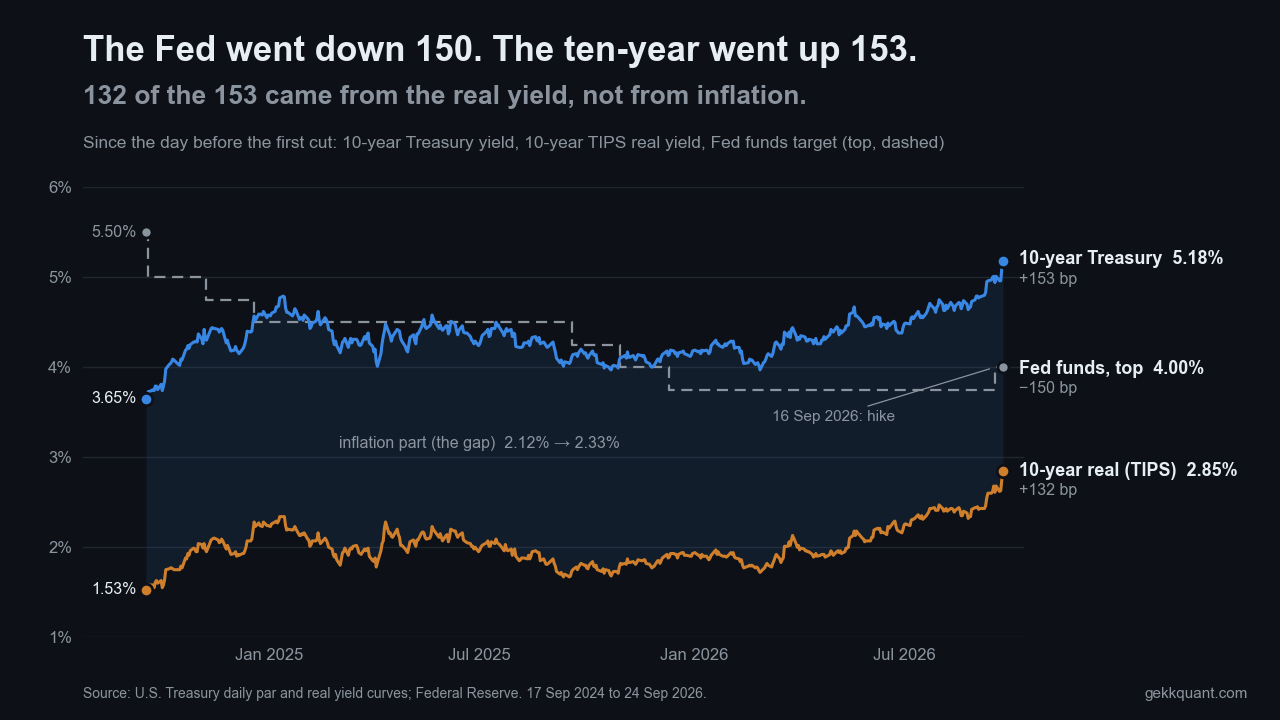
The Fed is 150 basis points lower. The ten-year is 153 higher. A full easing cycle and one hike later, the most important interest rate in the world has moved against its central bank almost point for point. And most of that climb is the real price of money, not fear of inflation.
Most of the week's commentary argued about whether that ends in a stock market crash. I think it argued about the wrong half of the yield. The half that moved is the half no Fed meeting and no Hormuz headline can reach.
First the recap. On September 16 the Fed raised its range by a quarter point to 3.75%–4.00%, its first increase since July 2023. That came after 175 basis points of cuts: 100 in late 2024, 75 more between September and December 2025. Fed Chair Kevin Warsh summed it up at the press conference: "So we removed a dose of accommodation." Not tightening. Removing accommodation. The chair told you policy was never tight in the first place.
Thursday's 5.18% close, eight days after the hike, was the ten-year's highest since July 2007.
Here's the split almost nobody prints. The Treasury sells two kinds of ten-year note. The ordinary one, and an inflation-protected one whose yield is the real rate, what you earn after inflation. The gap between the two is the market's inflation bet. Subtract, and the ten-year tells you what it's actually charging for.
Since the day before the first cut, the inflation-protected yield has gone from 1.53% to 2.85%. That's 132 of the 153 basis points. The inflation gap went from 2.12% to 2.33%. Twenty-one basis points, across two years that included the Hormuz closure and an oil shock.
So the bond market isn't panicking about prices. It's pricing inflation roughly where it priced it before the Fed ever cut. What it's repricing is the cost of borrowing real money for ten years, and that's a story about demand for capital, not about the price of eggs or diesel.
I spent Thursday night with the Treasury's two yield tables open side by side, which tells you everything about my Thursday nights. The subtraction took a minute. What it implies took the rest of the evening.
Warsh was asked about exactly this. Why are long yields up? He gave three reasons: economic strength, geopolitics, and one I'd underline twice. "The so-called hyperscalers are out in the market raising funding," he said. "And so the competition for capital is real."
That's the load-bearing sentence of the year, and he said it almost in passing. The second-quarter GDP report looked soft on the headline: 1.5% real growth. But private demand, consumer spending plus business and housing investment, grew 4.2%. In current dollars the economy grew at an 8.0% annual rate, and corporate profits were up 22.8% from a year earlier, the fastest since the end of 2021. An economy growing 8% in nominal terms, with its largest companies borrowing to pour concrete for data centers, doesn't borrow at a 4% policy rate and call it expensive. It bids for money. The real yield is the price where that bidding clears.
Now run the two fixes everyone is waiting for through the split.
Fix one is the Fed. It meets again on October 28, six days before the midterms, and plenty of this week's commentary asked whether it dares to hike that close to an election. For the ten-year it's the wrong question. A hike pulls long yields down only if it convinces the market that growth will slow and the Fed will have to reverse later. Warsh took that off the table himself: "I don't believe that we need to do harm to the labor markets to achieve our objective." A chair who promises higher short rates and no slowdown hasn't handed the ten-year a reason to fall. He's handed it a floor.
Before the meeting I wrote that a hike followed by a long-end rally would mean the market believed the tightening would bite demand, and a hike followed by a selloff would be a term premium story. We got the selloff. The split tells you what the premium is paying for: the real rate.
Fix two is Iran. A real Hormuz deal would send oil down and stocks up, hard. Fine. Oil works on the inflation half of the ten-year, and the inflation half is the half that isn't broken. Take it all the way back to where it stood before the first cut and you've taken 21 basis points off. Hold the real yield where it is and the ten-year would still sit near 4.97%. A Hormuz deal fixes the part of the yield that was never the problem.
This is why I keep coming back to the long end even though I trade index futures, not bonds. At the end of August I called it a warehouse that charges rent no speech can pay. The real-yield split names the tenant who keeps raising the rent.
And here's the part that should bother a Nasdaq trader most. The real yield is the discount rate on long-dated earnings, and nothing in the stock market is more long-dated than the AI build-out. So the loop runs like this. The hyperscalers borrow to build. The borrowing lifts the real rate. The real rate discounts the very cash flows the build-out is supposed to produce. The boom is bidding up its own discount rate.
That hits NQ harder than the Dow for the same reason a thirty-year bond swings harder than a two-year. A company whose cash arrives mostly a decade out loses more value for every point on the discount rate than one that gets paid this year. That's duration, and the index is loaded with it.
The trap follows from it. The one thing that breaks that loop is the borrowing slowing down, and the borrowing slowing down is also the thing that ends the AI capex trade. The ten-year gets cheap again when the Nasdaq's favorite story gets tired. You don't get the lower yield and the hot capex story at the same time.
So I don't buy "bonds are about to crash stocks" as a timing call. With profits growing 22.8%, earnings can outrun a 2.85% real yield for a while. A real-rate grind squeezes multiples. It doesn't pull the floor out on a schedule. What I do buy is the direction. Every Hormuz rally in NQ that happens with the real yield pinned near its high is a rally on the wrong half of the ten-year, and I'd rather sell those than chase them.
My line, so this is a position and not a mood: if the ten-year closes under 4.75% before the Fed meets on October 28, with the inflation-protected yield falling alongside it, then the real rate was never the story and I'll say so right here. Until then, stop watching the Fed for the long end. The long end stopped watching the Fed two years ago.
The Fed sets the price of money for tonight. The hyperscalers are setting it for the next ten years.
— Gekkquant · My trade signals live on Whop: https://whop.com/gekkquant/