
Diesel finished the week at $5.97 a gallon. That is a record on the weekly series the Energy Information Administration has kept since 1994, and it took out a mark set in June 2022 — back when everybody agreed we were living through an inflation crisis and the Fed was moving in 75 basis point steps.
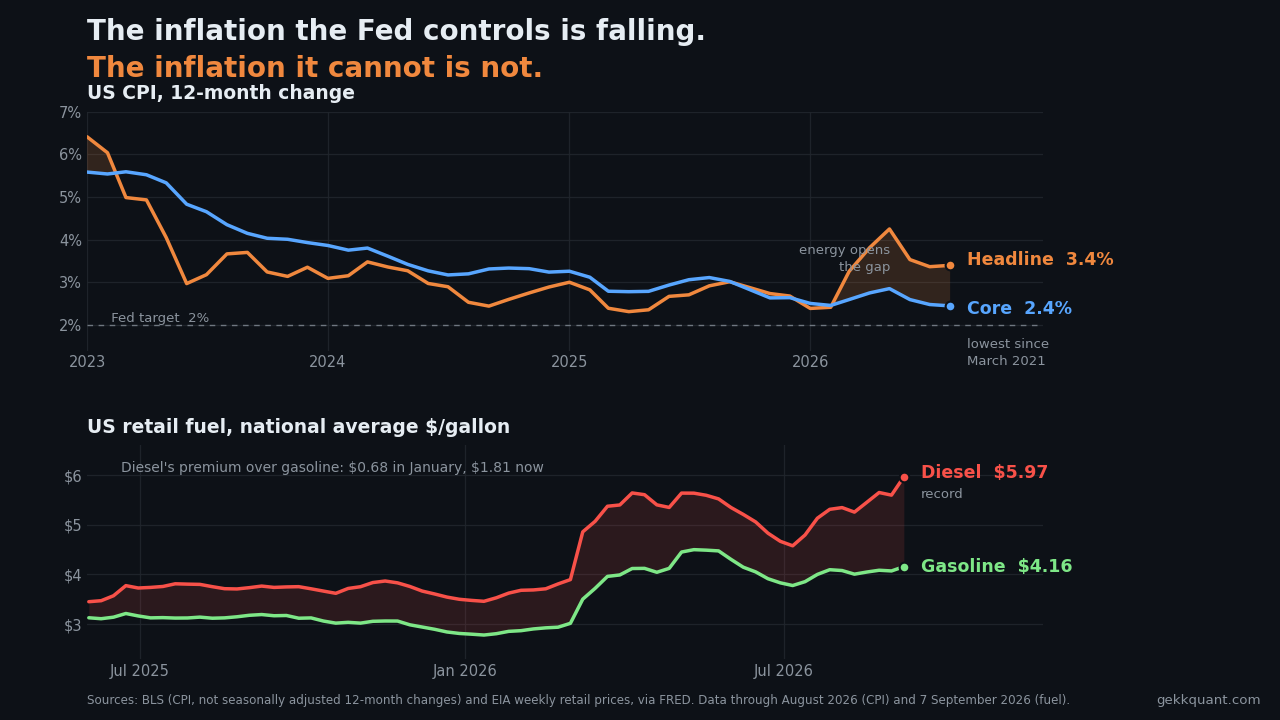
Here is the part that did not make the chyron. In that same week, core inflation printed 2.4%. Lowest since March 2021. That is 4.5 years.
Both things are true at once, and on Wednesday afternoon the Federal Reserve has to pick one of them to care about.
Start with the arithmetic, because the arithmetic is genuinely strange.
Gasoline is 3.77% of the consumer price index. Not 30%. Under 4. In August it rose 3.9%, and by the Bureau of Labor Statistics' own accounting that single line accounted for over a third of the entire monthly increase in prices. Roughly a thirtieth of the basket did a third of the work.
Now look at the other end of the same report. Shelter is 35.3% of the basket — 9 times gasoline's weight — and it rose 0.3%. Electricity fell. Piped gas fell. Energy services, the part of your energy bill that arrives through a wire or a pipe instead of a nozzle, fell 0.4%.
So the index did not rise because the economy ran hot. It rose because liquid fuel got expensive, and liquid fuel is close to a rounding error in the basket that happens to be printed in foot-high numbers on a sign every 3 blocks.
And it is not the barrel. That is the bit worth slowing down for.
If this were a crude shock, gasoline and diesel would move together. They have not. In January, diesel cost 68 cents more than gasoline. It now costs $1.81 more. That premium has nearly tripled this year while both fuels came out of the same barrels.
The margin is where it shows. The spread between diesel and the crude it is made from went through $100 a barrel this month, a record on an assessment published since 2009. A refining margin is setting the pump price, not a crude price.
That is what it looks like when the sorting machine breaks rather than the well. A barrel is not a faucet you open wider. It is a mixture you separate, and the diesel cut is a bounded fraction of what you feed in — set by the composition of the crude and the configuration of the unit, not by how much anyone wants. Lose the units and you have not lost oil. You have lost the ability to turn oil into the specific molecules that move freight. Ukrainian drones have spent this year methodically subtracting Russian refining capacity, and Russia answered by restricting its own fuel exports. The world has plenty of crude and not enough diesel. Those are different problems, and only one of them is on the table Wednesday.
US distillate inventories are running roughly 10% to 15% below their 5-year average. The EIA's September outlook has them dropping below 100 million barrels this month and staying under the 5-year low through the end of 2026 and most of 2027. Winter has not started yet.
So what does 25 basis points do to any of that?
Nothing. Not "a little". Nothing. There is no channel from the federal funds rate to hydrotreater capacity. A policy rate cannot rebuild a cracking unit in Ryazan, cannot re-flag a tanker, and cannot change the boiling range of a barrel of Urals.
The honest objection is better than that, though, and I would rather put it at full strength than knock over a straw version.
It goes like this: the Fed is not trying to manufacture diesel. It is trying to stop the diesel price from turning into everything else. Households do not compute a core rate. They see the sign. If the pump teaches people to expect 4% inflation, they ask for it in wages, firms post it in prices, and a supply shock quietly becomes a wage-price problem — which a policy rate absolutely can reach. That is the 1970s compressed into one sentence, and no central banker alive wants to be the one who ran it back.
I take that seriously. I just do not think it carries here. The measured pass-through from fuel prices into household inflation expectations is small: people weight the pump roughly in proportion to what they actually spend on it, which is the sane thing to do and not at all what the folklore claims. The correlation you can see on a chart is real. The causal push behind it is modest, and it fades at longer horizons. Long-run expectations have not moved. And a second-round effect needs a wage-setting environment willing to chase it — which is precisely what a 2.4% core, a 0.3% shelter print and a falling electricity bill tell you does not exist right now.
You tighten into a supply shock when the shock is leaking into everything else. This one is leaking into nothing. It is sitting in one cut of the barrel, screaming.
Here is what would make me wrong, and I would rather write it down now than relitigate it in December. If core CPI prints 0.4% or hotter month-on-month in either of the next 2 reports, the leak is real and I have been reading a lagging series with a straight face. If diesel's premium over gasoline narrows back toward a dollar while headline inflation stays above 3%, then energy was never doing the work I just said it was doing. Either of those, and the hawks were right and I was pattern-matching.
For the tape, though, the decision itself is not the event.
The 2-year note is at 4.56%. The funds range is 3.50% to 3.75%. That leaves the 2-year sitting about 80 basis points above the top of the range, which means the market has not priced a hike — it has priced roughly 3 of them. A quarter point on Wednesday is not news. It is arithmetic that already happened weeks ago.
What is not priced is the path, and the long end is where that gets settled. Thirties at 5.37%. Tens at 4.95%. If the Fed hikes and the long end rallies, the market is telling you it believes the tightening will bite demand: flatter curve, and the index takes its damage through growth rather than through rates. If the Fed hikes and the long end sells off anyway, that is a term premium story, and it means nobody believes a quarter point solves anything. Those are opposite trades off an identical headline.
I have been run over by exactly this setup before — right on the economics, wrong on the tape, because I traded the number instead of the sentence that came after it. So I will not carry a position into the release, and I will want one 20 minutes later.
The level I am watching is 5.00% on the 10-year. Through it and holding, and this stopped being a policy event and became a fiscal one.
The Fed spent 4 years earning back the right to be believed about 2%. On Wednesday it is being asked to spend some of that credibility on a number that is set by a distillation column in a country it sanctions.
I would not. But I am not the one who has to stand at a microphone and explain to a country paying $6 for diesel that the part of inflation the Fed can actually reach is already fixed.
— Gekkquant · My trade signals live on Whop: https://whop.com/gekkquant/