
Friday morning I had the Jackson Hole feed on one screen and the thirty-year quote on the other, and I'll admit I mostly watched the quote. Old habit. The speech tells you what they want. The long bond tells you what they'll get.
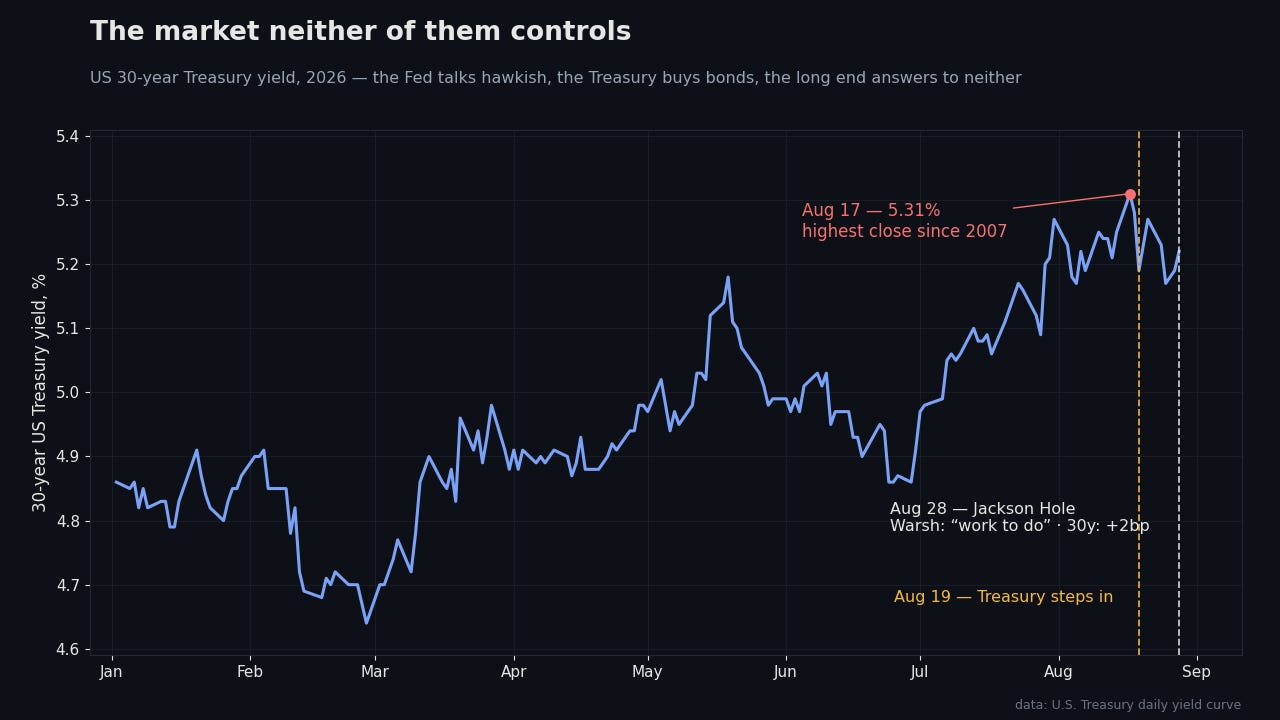
Kevin Warsh gave the hawks everything they ordered. “We must be confident that underlying inflation is moving to our objective, clearly and at sufficient speed. Otherwise, we have work to do.” The two-year believed him on the spot — up twelve basis points to 4.36% — which is the sound of a market repricing a chairman's spine in real time.
The thirty-year moved two basis points.
Two. The most deliberately hawkish Jackson Hole speech in years, delivered against 3.4% inflation, and the longest bond on the curve reacted like it had been read a weather report.
That split is the tell, and it's worth sitting with before the storyline sweeps you along. People say “the bond market” as if it votes as a bloc. It doesn't. The front end is a policy instrument: it trades meetings, dots and the chairman's nerve, and it will hand you a twelve-basis-point move for a single sentence. The long end is a warehouse. It has to store three decades of inflation risk, deficit risk and issuance, and it charges rent for the storage — the textbooks call the rent term premium, and no speech in Wyoming pays it. Two markets, one name. Most of the week's commentary never separated them.
Rewind eleven days to see why the shrug is the story. On August 17 the thirty-year closed at 5.31% — its highest close since June 2007, a nineteen-year door swinging open. Two days later the Treasury stepped into its own bond market. By month-end the step had a name and a schedule: buyback operations doubled from $2 billion to at least $4 billion apiece, aimed squarely at the 10-to-30-year sectors, running September 9 through November 4. The official term is “liquidity support.” Read that phrase twice. The issuer of the bonds is buying the bonds to support the price of the bonds, and the paperwork calls it plumbing.
So the financial commentariat spent the week writing the same essay under different mastheads: Treasury versus Fed. Bessent versus Warsh. Fiscal dominance versus independence, pick your champion, place your bets on who blinks.
Wrong fight. Both institutions lost the same week, to the same counterparty, and almost nobody printed the scoreline.
Read the curve the way a trader reads it. The two-year did exactly what Warsh told it to do — plus twelve. The front end is his; it prices meetings, and he chairs the meetings. The thirty-year did nothing for him — plus two — and it has done nothing durable for Bessent either: after the intervention headlines it dipped, wandered, and today still sits within a dozen basis points of that nineteen-year high. The front end obeys the Fed. The long end obeys arithmetic: thirty-two trillion dollars of Treasury debt in public hands, a deficit running near six percent of GDP with unemployment at just 4.1%, and a buyer base being asked to hold thirty-year promises at 3.4% inflation.
I trained as a chemist before I traded futures, so here's the ratio that matters to me: four billion an operation against a thirty-two trillion dollar market is a buffer solution defending pH against a tanker of acid. Buffers genuinely work — right up until their capacity is consumed. Then the reading jumps as if the buffer had never been there, and everyone who trusted the stability discovers it was capacity, not equilibrium.
Now the part almost nobody says out loud, and the reason I refuse to join the “unprecedented” chorus: we have run this exact experiment before, at full scale, for nine years — and it worked, which is precisely what should worry you. From April 1942 to March 1951 the Federal Reserve pegged Treasury bills at three-eighths of one percent and capped the long bond at 2.5%, because the Treasury told it to. The entire yield curve, administered in broad daylight, for a decade. Fed independence — the thing Warsh flew to Wyoming to perform — is not constitutional bedrock. It dates to a truce signed in March 1951, when the Fed finally refused to keep financing inflation at a fixed price. The Accord is the birth certificate of the modern Fed, and it is younger than Warren Buffett.
And notice what it took to end the arrangement. Not a philosophy seminar — a war. When Korean War inflation surged, the Fed found itself printing money to defend the Treasury's cap while prices ran, and it finally walked. The peg didn't die because someone won a debate about central-bank independence. It died because the cost of holding it became unpayable. File that under things which rhyme.
So when I watch the Treasury double its buybacks “for liquidity,” I don't see innovation. I see the pre-1951 world being rebuilt in miniature, politely, with press releases — with one difference that decides everything. In 1942 the peg held because the institution doing the buying printed the money and could not run out. In 2026 the institution doing the buying is the borrower. A yield cap enforced by the printer is policy. A yield cap attempted by the debtor is a squeeze announcement on government letterhead.
I'll give you my line in the sand, because a view without one is content, not a position. The buyback window runs September 9 to November 4. If the thirty-year spends that window making lower highs — through the auctions, not around them — and settles convincingly back under 5% while CPI holds in the mid-threes, I'm wrong: the long end can be managed after all, the 1951 lesson has expired, and I'll write that admission right here. My actual expectation is duller and harder: the long bond only truly rallies when recession odds do the work. The one force that reliably caps long yields is a collapse in the private demand for money — never an increase in the supply of press releases.
Why does an index-futures trader care this much about a bond he doesn't trade? Because the long end is the discount rate on every growth story the Nasdaq owns. The further out a company's promised cash flows live, the harder a 5.3% thirty-year taxes them — and no index on earth owns more distant promises than the Nasdaq 100. NQ spent August being repriced by that one print more than by any single earnings call, and the overnight futures deliver the verdict every morning, hours before the cash session opens.
The week fits in three lines. The Fed chair talked, and the front end moved. The Treasury bought, and nothing moved. The long bond listened to both — and repriced neither.
Keep your eyes on the only vote that counts.
— Gekkquant · My trade signals live on Whop: https://whop.com/gekkquant/