
Nobody lost $20 billion on Thursday. The chip index still fell 3.4% as if somebody had. The Financial Times reported that OpenAI's annualized revenue stood near $50 billion at the end of September, against the roughly $70 billion doing the rounds a week earlier, and the AI complex sold first and read later. Oracle dropped more than 5%. Nvidia gave up 2.9%.
Here's my read, up front: the $20 billion is a counting rule, not lost demand. And the fight over it hides the number that should actually worry anyone trading NQ. That number isn't revenue. It's the bill.
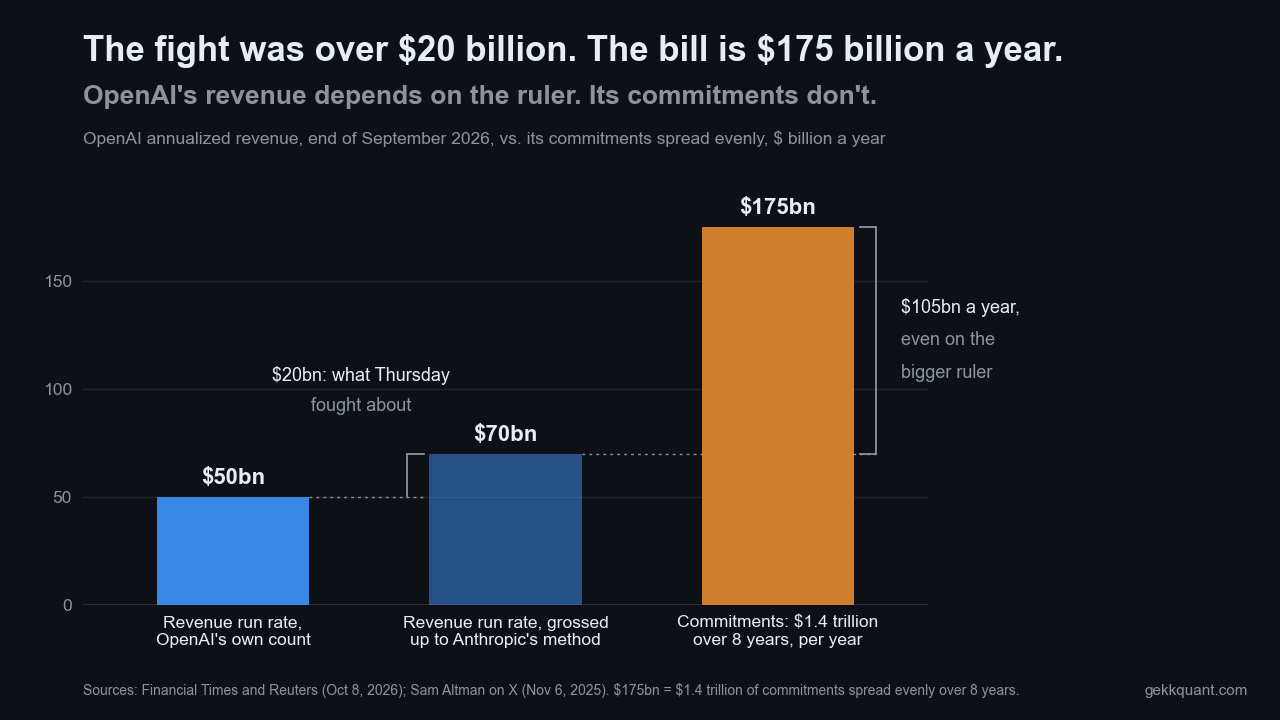
Start with the rule. Anthropic counts the full value of the sales of its models made through Amazon's and Google's clouds, and pays the cloud its cut out of that. OpenAI counts only its own cut. Anthropic hands its cloud partners about 16 cents of every dollar sold that way, and those sales made up half of its revenue last year. That's the whole gap. The near-$70 billion was OpenAI grossed up to sit next to Anthropic on the same ruler. The $50 billion is OpenAI on its own.
Same customers, same tokens, same servers humming in the same data halls. Two numbers, both honest, $20 billion apart.
Neither of them is cooking anything, either. US accounting rules let a seller book the gross price when it controls the service before the customer gets it, and force it to book only its net fee when it's acting as somebody else's agent. Where a model sold through a cloud marketplace lands on that line is a judgment call, and the two labs made opposite calls. That's a footnote dispute, not a demand story.
And both rest on a run rate, which is often one month's revenue times 12. It's unaudited. It comes from two private companies, shared with investors in the middle of fundraising. It isn't a 10-Q, and nobody signs it under penalty of anything. Yet a change of ruler on that number knocked more than 3% off the semiconductor index in a single session. If you want to know how soft the ground under the AI equity trade is, that's your answer. The market prices the stocks off numbers nobody audits.
I spent Thursday evening with revenue-recognition footnotes instead of the closing auction, which tells you the kind of week it was. The footnotes settle one thing fast: on the revenue side you can always pick another ruler. On the cost side you can't.
In November 2025, Sam Altman put OpenAI's commitments at about $1.4 trillion over the next 8 years, mostly data centers and chips. In the same breath he said the company would end 2025 above a $20 billion run rate. Spread that bill evenly and it comes to $175 billion a year.
Now hold September's revenue up against it. On the net ruler, $50 billion. On the gross one, near $70 billion. Either way, the hole to the annual bill runs $105 billion to $125 billion. The market spent Thursday fighting over $20 billion. The gap that matters is five to six times bigger, and no change of accounting closes it.
That bill doesn't float in space either. It lands on balance sheets that sit in the indices. Oracle's remaining performance obligations, contracted revenue it hasn't booked yet, reached $664 billion at the end of August. Next to it sits OpenAI's own figure for the capacity Oracle is building for it: a partnership worth some $300 billion over five years. A contract is only as good as the buyer's ability to pay, and that buyer just reminded everyone its revenue depends on which ruler you use.
Follow that dollar one more step and you're inside the futures. OpenAI's commitment becomes Oracle's build-out, the build-out becomes chip orders, and the chipmakers at the end of that chain, Nvidia, Broadcom and AMD among them, all sit in the Nasdaq-100 that NQ tracks. That's how a private company's spreadsheet ends up in your P&L on a Thursday afternoon.
Last week I laid out how the index books the AI build-out as profit now and as cost later. This is the same machine seen from the other end. Equity holders get paid on the soft number. Lenders get paid on the hard one.
If you want proof the hard number gets priced, look at Meta's Hyperion campus in Louisiana. In October 2025 Meta put it into a joint venture owned 80% by Blue Owl funds and 20% by Meta. The Blue Owl side, a vehicle called Beignet Investor, sold about $27 billion of bonds due 2049 with a 6.58% coupon. Meta pays rent, the rent pays the bondholders, and Meta's own filings treat the venture as unconsolidated, so the debt isn't on Meta's balance sheet.
Look at what the market charged for that wrapper. S&P rated the notes A+, one notch under Meta's own AA-, and they came at about a point more than the roughly 5.5% yield on Meta's comparable corporate bond. Same tenant, same cash flow, a full point extra for keeping the debt out of sight.
Then the price ran the other way. By late September the notes, sold at par, were trading around 91 cents on the dollar, with the yield as high as 7.55%, about 230 basis points over Treasuries. That repricing came before anybody had heard of the $50 billion. The bond desk marked down the AI bill more than a week before the equity desk panicked over a definition. Borrowing on that scale is part of why the long end refuses to come down, Fed or no Fed.
That's the order these things run in. Credit leaks first, quietly, at the back of the book. The stocks find out later, usually on a headline that's technically about something else. Thursday was that headline.
Thursday sold the wrong number for the right reason.
The wrong number: the $20 billion will mostly turn into a footnote. According to Bloomberg, OpenAI is still telling investors it expects to reach or exceed $70 billion of annualized revenue by the end of the year, on its own net basis. Fine. Let them.
The right reason: the question for NQ was never whether OpenAI is a $50 billion company or a $70 billion one. It's whether a $175-billion-a-year bill gets paid out of revenue or out of fresh money, debt and equity raised against the promise, and right now it's fresh money. As long as the lenders keep asking more for the same tenant, the stocks that sit at the front of that queue carry the risk, whatever the run rate says.
So here's my side. I'd rather own the payers, the companies funding the build-out from their own cash flow, than the builders whose backlog leans on one startup's promise. On NQ, I sell the rallies that get bought on "it was only accounting" until the credit side stops leaking.
Where I'm wrong, in two numbers. OpenAI prints $70 billion or more on its own net ruler by December 31, which takes 40% growth in a single quarter. And the Hyperion notes climb back above 95 cents. If both happen, the bill is getting paid out of revenue, and I'll say so right here.
Until then, keep this straight: revenue is whatever ruler you pick. Rent is due on the first.
— Gekkquant · My trade signals live on Whop: https://whop.com/gekkquant/