
The Nasdaq-100 closed Friday at 30,807.93, the highest close in its history. In the same session the equal-weight S&P500, the version that gives every member the same vote, locked in its 7th straight losing week. It last strung together a run like that in the spring of 2022.
Most of the week's commentary filed that under breadth. I file it under accounting. The record and the slide are the same trade: the index is being carried by a single budget line, the hyperscalers' capital spending, and right now the market books that bill as profit.
Nobody's arguing the breadth is pretty. Goldman Sachs says it has fallen to its lowest since the dot-com bubble, with the median S&P500 stock 16% below its 52-week high, while the index itself closed Friday about 1% under its August 13 record. The bears see a crash setup. The bulls see laggards about to catch up. Both camps are counting stocks. Count dollars instead.
Goldman reckons the largest US hyperscalers will spend $800 billion on capex this year, 94% more than in 2025, and that almost half of the S&P500's earnings growth in 2026 comes from AI investment. And that earnings growth is no rounding error. By Goldman's count, S&P500 earnings per share rose 51% year over year in Q2 and 26% over the past 4 quarters, against a 30-year average of 7%.
Here's how a dollar pulls that off. When a hyperscaler buys a rack of accelerators, the chipmaker books the sale as revenue that quarter. The buyer books almost none of it as an expense. The rack goes onto the balance sheet and gets depreciated over years: Alphabet, for example, uses a 6-year life for its servers. Put numbers on it: a $6 billion server order on a 6-year life is $6 billion of revenue for the seller now and $250 million of depreciation a quarter for the buyer, for the next 24 quarters. Both companies sit in the index. So the S&P500 books the purchase as profit up front and as cost in installments. None of that is a scandal. It's how accrual accounting treats every build-out, from railroads to fiber: the suppliers book their sales right away, and the owners book the cost over the asset's life. The trouble is always the timing.
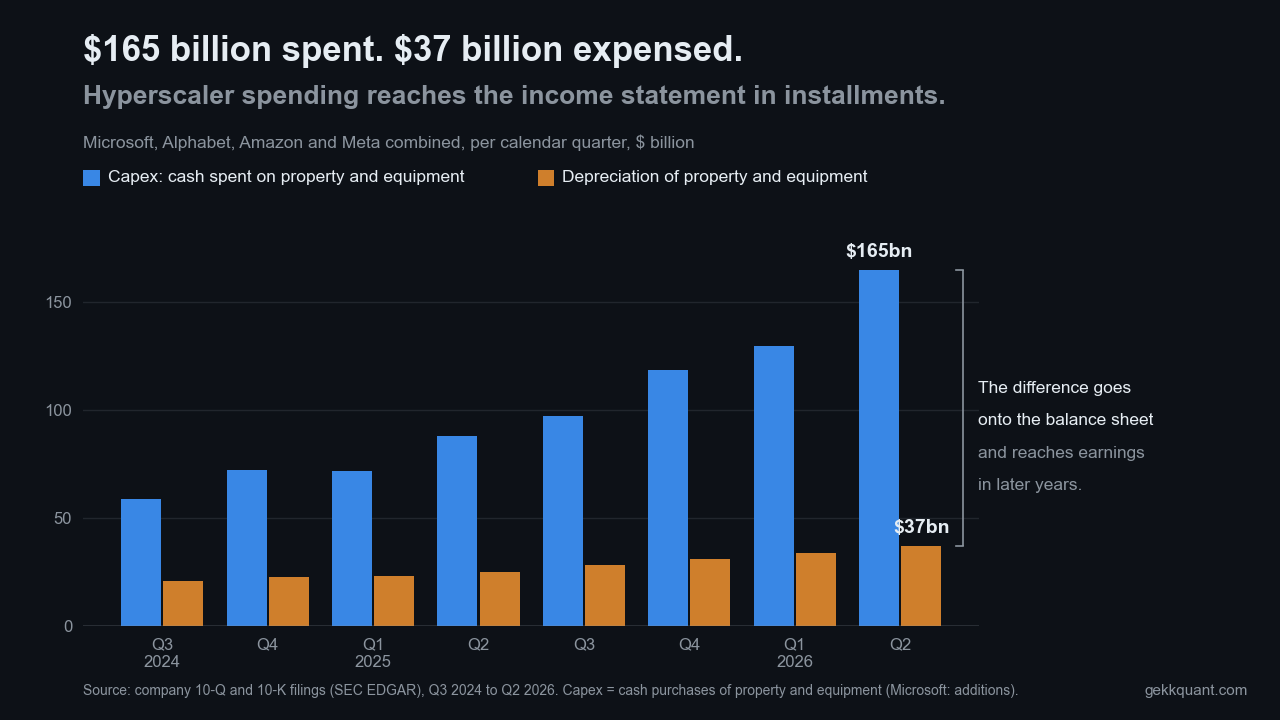
I went through the filings to see how wide that gap runs. In the April-to-June quarter, Microsoft, Alphabet, Amazon and Meta spent $165 billion in cash on property and equipment. They booked $37 billion of depreciation. Spending outran depreciation by more than 4 to 1, and the difference doesn't vanish. It sits on 4 balance sheets and reaches the income statement over the coming years.
Reading 4 sets of footnotes back to back is nobody's idea of a Saturday, mine included. But that's where this bill sits, and it says more than the index level does.
That's the part of the boom where money actually changes hands. Another part doesn't need any. Goldman counts roughly $150 billion of unrealized gains that large tech companies booked on their stakes in private companies in Q2, worth 12% of S&P500 earnings per share. Marks, not cash. Goldman expects more of it before year-end and a much smaller contribution in 2027.
Now the bit almost nobody prices. A supplier's revenue tracks the hyperscalers' budget. Its revenue growth tracks the raise in that budget. Earnings growth comes from the raise, not from the budget. Goldman's analysts expect hyperscaler capex of $1.2 trillion in 2027 and $1.4 trillion in 2028. Look at the raises instead. In dollars, next year's raise is about the size of this year's. In 2028 it shrinks. The budget sets a record every year. The raise doesn't.
Depreciation doesn't care. It's the echo of every rack bought over the past several years, and it keeps climbing whether the budget grows or not. Goldman puts the drag from hyperscaler depreciation at 5 percentage points of S&P500 earnings growth in 2027, against an 11-point boost from the spending. By 2028, it says, the drag offsets the boost. So in the year the build-out is expected to spend $1.4 trillion, it adds roughly nothing to the index's earnings growth, net.
Back on September 19 I listed a hyperscaler trimming next year's capex and blaming the pacing talk among the things that would make me wrong. The arithmetic says nobody has to trim a cent. The boost fades on a budget that keeps growing, as long as it grows by less.
That makes next year's capex plans the most important number in the market, bigger than anything in a dot plot. Goldman figures a $250 billion surprise in either direction next year moves S&P500 earnings growth by about 6 percentage points. The Fed decides on October 28. For index earnings, the next round of hyperscaler earnings calls matters more than that press conference.
Last week I argued the build-out is bidding up its own discount rate, its borrowing among the reasons the 10-year Treasury closed Friday at 5.28%. Put the 2 pieces together and the breadth chart stops looking mysterious. The loop pays the companies inside it in sales and again in marks, and charges everyone outside it the higher price of money. A company that borrows to grow and sells nothing into the build-out pays the new rate and gets none of the orders. The equal-weight index is the outside.
That's why Friday's record doesn't impress me much, and NQ is the market I trade. The Nasdaq-100 owns both ends of the invoice: the buyers, Microsoft, Alphabet, Amazon and Meta, and the sellers, Nvidia and Broadcom. On the way up it gets paid twice. When the raise shrinks, it gets billed twice: the sellers' growth fades while the buyers' depreciation keeps climbing.
For anyone trading NQ, that moves the event risk. The number to watch on the hyperscalers' next calls isn't cloud growth. It's the capex line, read as a raise. A guide that rises by less than this year's raise is a slowdown for the sellers, even when the headline says record.
The bull case deserves its best version. If next year's plans come in $250 billion hot, the boost doesn't fade in 2027. It grows. Goldman's own strategists aren't bearish either: they see the S&P500 at 8,700 within 12 months, with earnings growing about 11% in both 2027 and 2028. Maybe. But with the spending boost netting out to roughly nothing by 2028, something else has to carry those numbers, and the depreciation from this year's $800 billion is already scheduled, whatever anyone guides.
So here's my position. I'm not shorting the average stock. With the median name 16% off its 52-week high and a 10-year above 5%, it already wears the cost of money. And I'm not paying 2026's earnings growth for 2027's earnings. From Friday's closes, 30,807.93 on the Nasdaq-100 and 8,498.79 on the equal-weight S&P500, I'd rather own the average stock than the loop into year-end. If the Nasdaq-100 has outrun it by December 31, the loop had more fuel than the arithmetic says, and I'll say so right here.
The market isn't narrow because 7 companies are strong. It's narrow because the same invoice gets counted as profit by the seller and hasn't reached the buyer's income statement yet.
— Gekkquant · My trade signals live on Whop: https://whop.com/gekkquant/