
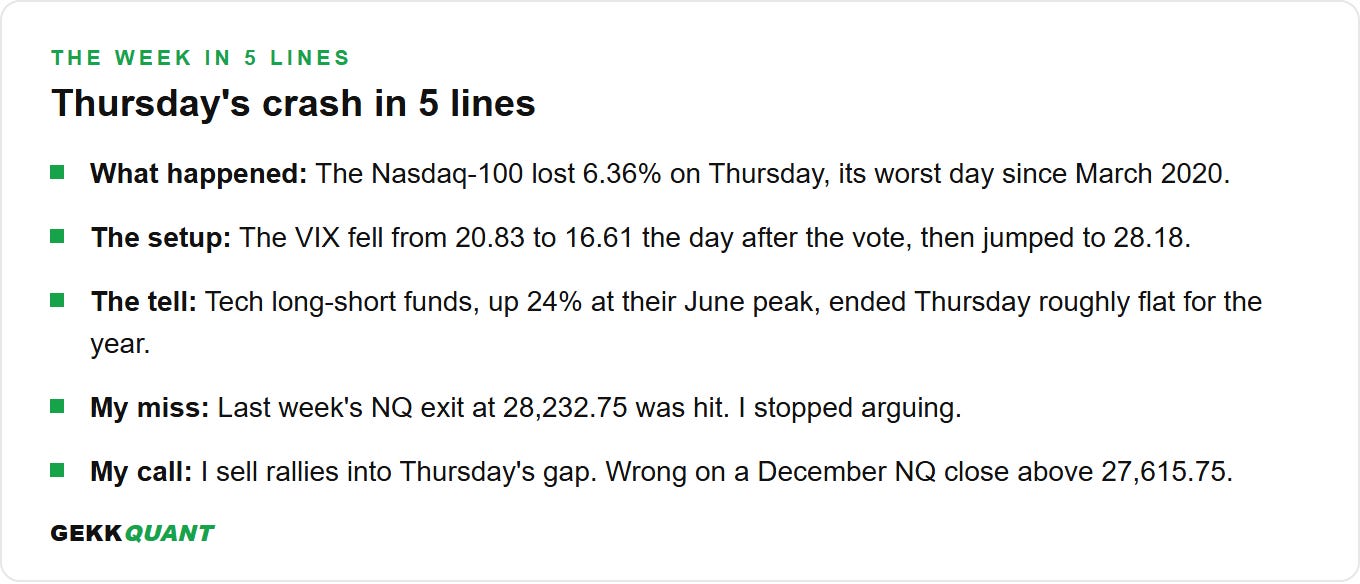
Last Sunday I put my exit in writing: if December NQ closed Friday below 28,232.75, the market had priced something bigger than hearings, and I'd stop arguing with it. It closed well under it. So I've stopped. The useful part is why I was wrong, because the reason isn't the one on your screen.
Thursday's 6.36% drop in the Nasdaq-100 wasn't fear arriving. It was calm leaving. The vote was a day old when Thursday opened. The selling came from crowded books that had just loaded up again.
The calm was the setup
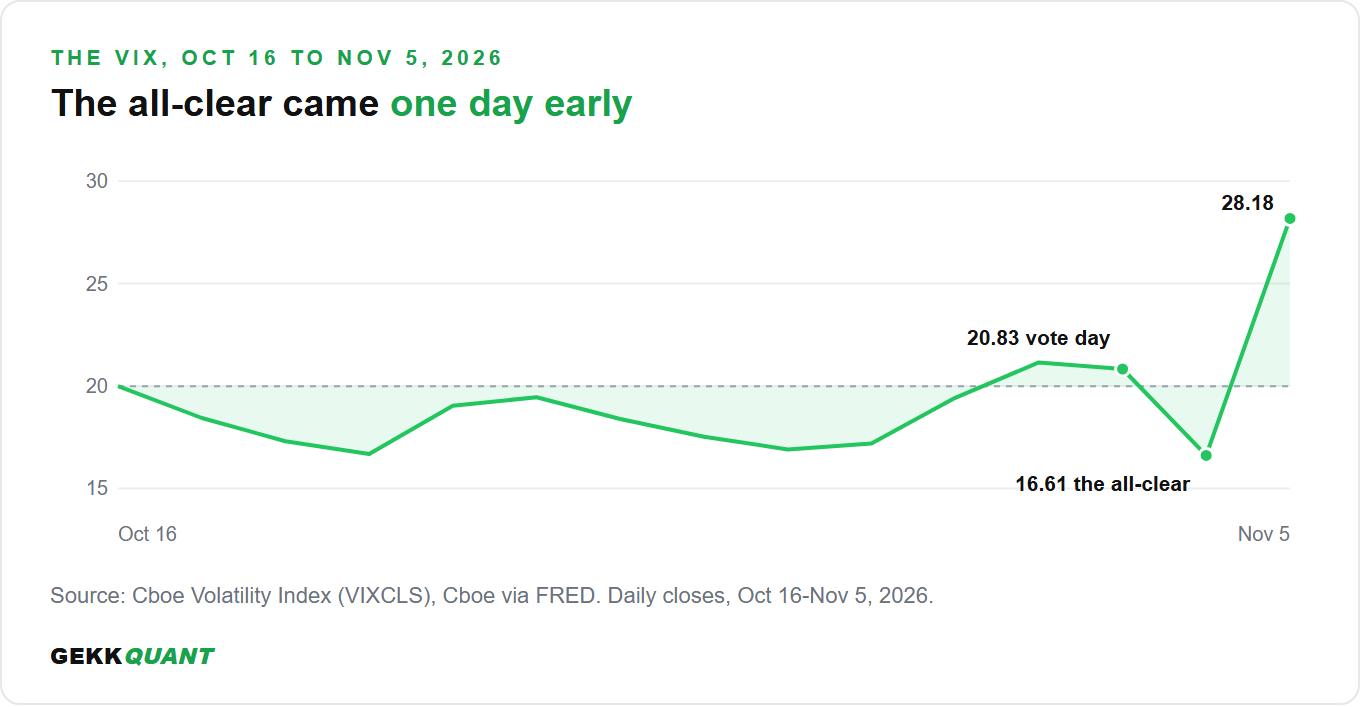
Look at the VIX. On election day it closed at 20.83. On Wednesday, with Democrats holding both chambers and the result priced, it fell to 16.61. On Thursday it closed at 28.18.
That Wednesday drop is the whole story. When implied volatility loses a fifth in a day, every risk model on the Street hears the same thing: the event is gone, you can carry more. Goldman's John Flood said it plainly in a note: funds that had de-risked hard into the vote chased Wednesday's relief rally and got caught wrong-footed a day later. I liked that Wednesday tape too. I'll own that.
Think of a supersaturated solution. It looks clear and perfectly still, and one seed crystal turns the whole flask solid. The calm isn't the opposite of the crash. It's the precondition.
Same trade, same door
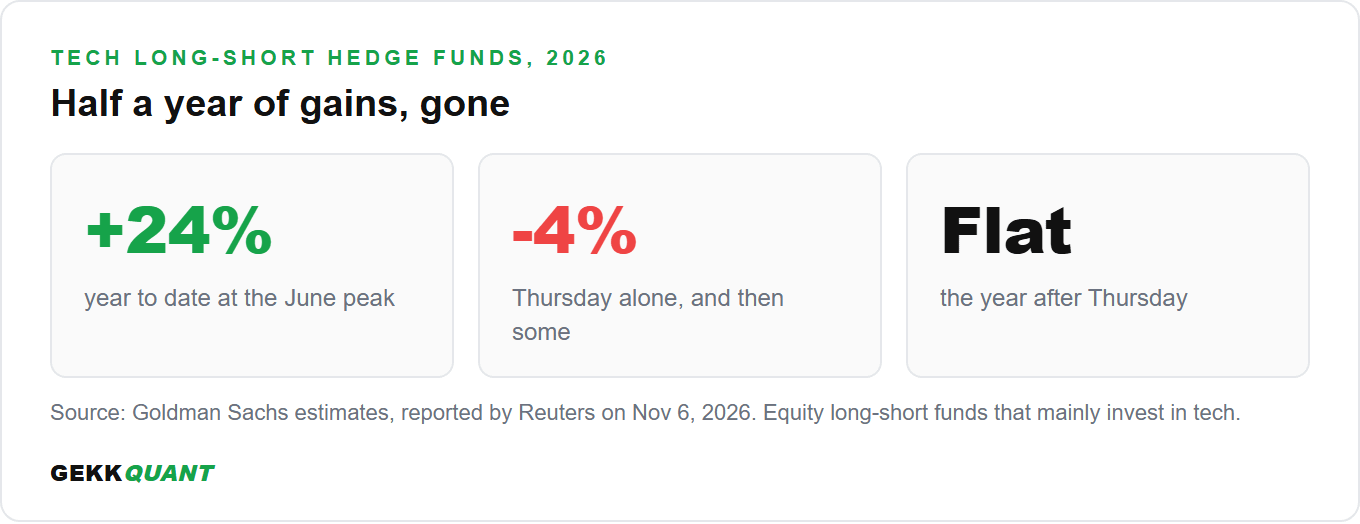
Here's the number that stopped me. Tech-focused long-short hedge funds were up 24% at their June peak, by Goldman's estimates. Thursday they fell more than 4% in a single session, and that left them roughly flat for the year. Half a year of gains, finished off in one session.
That's why the tape looked so ugly without one earnings miss to blame. A pod manager's stop isn't a price, it's a drawdown limit. Hit it and the risk desk cuts the book, whatever the story says. And the books look alike: PivotalPath flagged a high and rising overlap among the 10 largest multi-strategy funds, so their exits run through the same names. Walleye, a $17 billion fund, told its investors on Thursday it would hand back part of the capital.
What I do now
Friday's bounce came with a jobs beat: 165,000 payrolls against 65,000 expected, and traders pricing about an 80% chance of a December hike. A rally that has to climb over a rate hike isn't the forced sellers finishing. Platforms cut leverage over weeks, not in one afternoon, and the people who run them expect more cuts if prices keep sliding. This is the AI financing bill meeting the money that was levered to it.
Keep the mechanism, because it'll come back. After a binary event, implied volatility collapses, and everything sized on volatility gets bigger at once: the pods, the vol-targeting money, your own position if you size off the VIX. The size goes up exactly when the event's real consequence hasn't traded yet. The next time the VIX loses a fifth on an all-clear, cut your size. Don't add to it.
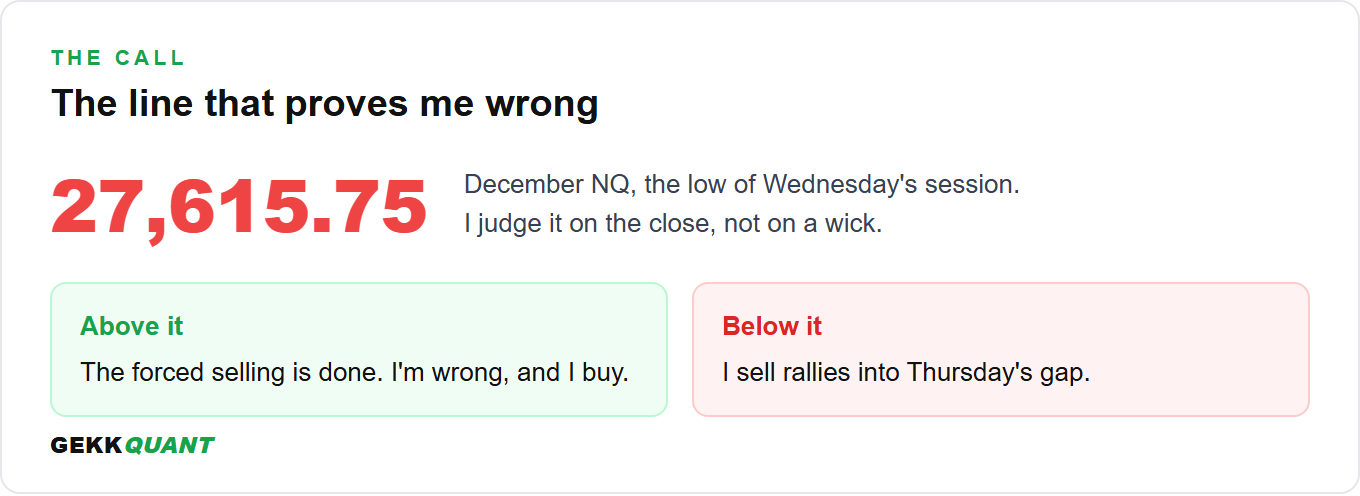
So I sell rallies into Thursday's gap; I don't buy them. Here's what proves me wrong: a December NQ close above 27,615.75, the low of Wednesday's session. Above it, the forced selling is done, and I'll buy with you.
The crash didn't start on Thursday. It started on Wednesday, when the VIX told everyone it was safe.
Everything you need, the weekly futures signals included, sits in one place: https://whop.com/gekkquant/.