
If you still circle FOMC Wednesdays in red, you've been trading off the wrong calendar. The Fed delivered its first rate hike since 2023 on September 16, and the 2-year Treasury yield rose 7 basis points. Just 15 days later, Vice Chair Philip Jefferson gave a talk at the University of Virginia, and the 2-year fell 10.
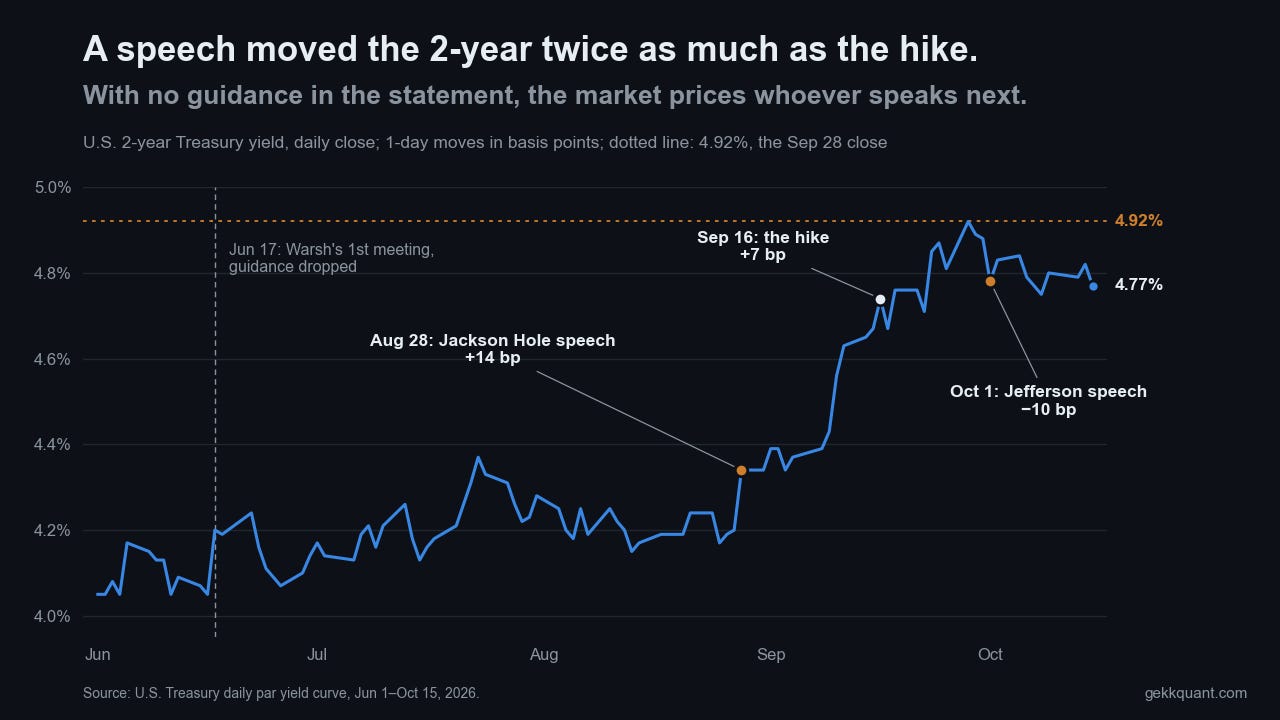
My read, and I'll own it: Kevin Warsh didn't abolish forward guidance in June. He decentralized it. The statement went quiet, and the guidance moved into speeches, minutes and data prints, where it shows up late, uncoordinated and in pieces. That isn't less volatility. It's the same volatility, spread over more days.
Start with the regime change. At Warsh's first meeting as chair, on June 17, the Fed held the funds rate at 3.50% to 3.75% and cut the forward guidance out of the statement. No more sentences about the path. No more promises. In principle, I've got no quarrel with that. A central bank sitting well above zero, with inflation running hot, has no business pre-committing to anything.
But a market doesn't stop needing a path because the Fed stops drawing one. It draws its own. And it draws it from whatever the Fed hands it next.
Watch what it grabbed first. On August 28, at Jackson Hole, Warsh said the Fed would "have work to do" if policymakers weren't confident inflation was heading back to 2%. No decision, no vote, a single conditional sentence. The 2-year jumped from 4.20% to 4.34% at the close. That's 14 basis points for a hint, against 7 for the actual hike 3 weeks later. I wrote the week of that speech that nobody at the Fed controls this market on their own. The tape has spent every week since proving it.
Then came the round trip that should've ended the debate. On Monday, September 28, the 2-year closed at 4.92%, and fed funds futures priced about a 70% chance of another hike on October 28. On Tuesday, New York Fed President John Williams told an audience in Buffalo there's "no need for urgency, and we have time to gather more information." On Thursday, Jefferson said, "My colleagues and I will need to come to our own judgment, which may take more time." By Thursday, the October odds were down to roughly a quarter.
From 70 to 25 in 4 days. No meeting in between. Just 2 speeches, with the August PCE inflation print landing between them on Wednesday.
That's forward guidance. Whoever holds a microphone that week delivers it now, instead of the committee speaking together on a single afternoon.
The minutes made the gap plain. The September dots had already told the market that most officials expected another hike before year end. What the dots couldn't say was why. The minutes did, on October 7, 3 weeks after the hike: many participants backed the move on risk-management grounds, as insurance against inflation that won't come down, and most saw another increase as likely appropriate by year end. Insurance or forecast is the whole question for the next meeting, and under Warsh the answer reached the market 21 days late, after Fed officials had already talked the price up and back down. The next day, Governor Christopher Waller flew the point to Istanbul: policymakers can still signal the range of choices they're weighing, he argued, without locking in a path. When a governor has to cross an ocean to explain how the Fed still signals, the signal clearly went somewhere.
Now put the data on top. September's CPI landed on October 14: 3.7% over 12 months, up from 3.4% in August. Core, without food and energy, ran at 2.6%. That gap is energy, and a rate hike doesn't produce diesel. The October odds still jumped from about 22% the day before to better than a third the same day, because with no guidance in the statement, the latest print is the guidance. On October 16, in Bangkok, Warsh put it in a single line: "I don't believe in saying now what I might do at the meetings." The hike bets faded again while he spoke.
Now the part nobody seems to have priced. Until February 4, 1994, the Fed didn't announce its decisions at all. Traders watched the New York Fed's trading desk and inferred from its open market operations whether policy had changed. That's 32 years of building the talking central bank, from that first statement to dot plots and press conferences, and in June the statement went back to saying nothing about tomorrow. And on October 12, Stockholm handed the Nobel to Robert Hall and Michael Woodford, whose models gave central banks the theoretical base they still run on. Woodford's 2012 Jackson Hole paper is the playbook for steering a market with words when the rate can't move: forward guidance at the lower bound.
So the prize for building the machinery of guidance landed 4 months after the Fed switched the machinery off. And 4 days before the chair told the world he doesn't do previews.
The mechanism is simple, and the chemist in me recognizes it. Forward guidance worked like a buffer in a solution. New information still came in, but the buffer absorbed most of it, so the price didn't jump with every drop. Pull the buffer, and every drop moves the reading. A campus speech, a footnote in the minutes, a hot CPI line: each one now has to do the job the statement used to do, and each one does it with a bigger swing.
For anyone trading index futures, this changes where the risk sits. The 2-year is the market's running bet on the next 2 years of Fed policy, and NQ is a long-duration asset: its value leans on earnings years out, so it reprices hard when that bet moves. The old event was the statement at 1:00 p.m. CT on 8 Wednesdays a year. The new events are every scheduled Fed speaker and the 7:30 a.m. CT data prints. That's why the pre-market hour matters more to an NQ session right now than the FOMC statement does. The repricing hits before the cash open, and the open inherits it. (Yes, I now read the Fed's speaking calendar on Sunday night. It's become the most useful page the Fed publishes.)
The fix doesn't need a single promise about the path. It needs the reason, on decision day. An insurance hike invites a pause. A forecast hike invites the next one. A few dozen words in the statement would've told the market which kind it just got. Leave them out, and the market has to reverse-engineer the answer from whichever official speaks next, which is exactly the 70-to-25 round trip we just watched.
None of this means Warsh is wrong to want a quieter Fed. Woodford built his own case for heavy guidance around a central bank stuck at zero, unable to move the rate. This Fed can move the rate, and it just did. The mistake is thinking silence removes the signal. It doesn't. It removes the editor.
My call for October 27–28: no hike. The statement stays short, Warsh stays vague, and the move comes on December 8–9, the meeting that carries the projections. Williams already said "late this year." The minutes already said "by year end." That's 2 Fed sources pointing at December, delivered by the exact back channel this regime runs on.
What proves me wrong? The 2-year finished the week around 4.7%. If it closes back above 4.92% before the meeting, the level it hit when the market priced October at about 70%, the market is telling me October is live, and I'll own the miss. Below that, I'm treating every Fed speech between now and the 28th as the real meeting, and the meeting itself as the formality.
The Fed didn't go quiet. It stopped speaking as a committee. And a market without a script prices every voice it can hear.
— Gekkquant · My trade signals live on Whop: https://whop.com/gekkquant/