
On Monday the chip index had its worst day since early July. The Philadelphia Semiconductor Index lost 5.86% after the man who runs Anthropic published 3,800 words on Saturday asking his own industry to slow down, and Sam Altman and Elon Musk said within a day that they agreed.
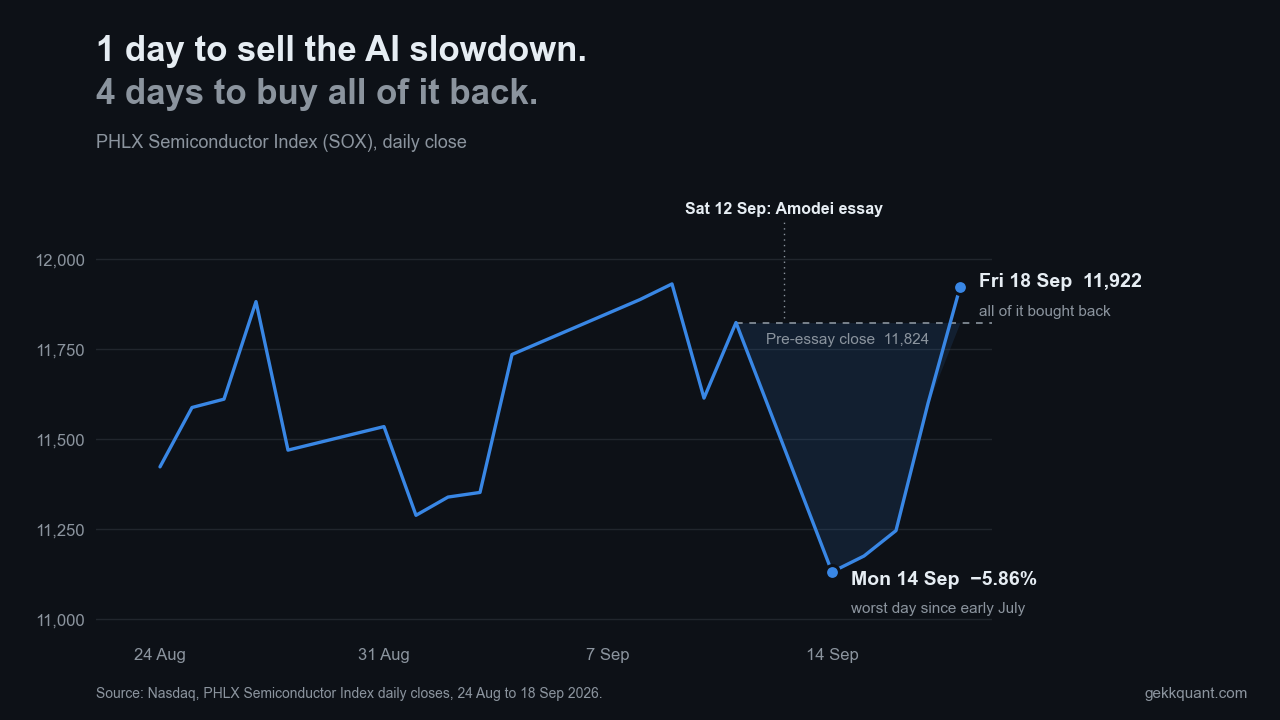
By Friday's close it was back at 11,922, above where it stood before anyone had read a word of the essay. It took 4 sessions. That's how long the market spent pricing the end of the AI arms race.
I don't think that was complacency. I think the market read the footnote.
I read the essay twice on Saturday night. Read it as a trader and you get the bold thesis: slow the pace at which AI capabilities improve. Read it the way my economics professors trained me to read anything a CEO writes, and you find the sentence that decides whether any of it happens. For antitrust reasons, Amodei writes, Washington doesn't need to sit at the table, but it does need to issue a narrow waiver for certain safety conversations.
Sit with that for a second. The CEO of a frontier lab is asking the government for legal permission to agree with his competitors. He needs it because every slowdown runs into the same wall: a lab that brakes alone just hands the lead to the one that doesn't. So a slowdown only works as a pact, and a pact among rivals to hold back what they bring to market is exactly what antitrust law exists to stop. Good intentions have never been a defense.
Detroit learned that in 1969. That January the Justice Department sued General Motors, Ford, Chrysler and American Motors under the Sherman Act. The charge: for 16 years they had agreed among themselves to slow the arrival of pollution-control technology, with nobody moving first and new devices reaching buyers only on an agreed schedule. It had started in 1953 as a joint research pact on smog. They settled with a consent decree before the year was out, admitting nothing.
Swap smog devices for frontier models and the shape is the same: rivals, a shared calendar, nobody allowed ahead. Detroit stood accused of going slow on a technology the public wanted. The labs want to go slow on one they fear. The statute doesn't grade which way the good intentions point, and that's why the footnote exists.
The order of the steps tells the same story. Step 1 puts outside evaluators inside each lab, with desks, badges and the right to publish what they find. Step 2 is the shared limits. Economists have known since the 1960s why agreements among rivals fall apart: every member cheats unless it believes it will get caught. In that logic the monitor has to arrive before the limits, and in the essay it does. Take the safety motive at face value. The architecture is still the one the FTC gets paid to worry about.
So the whole slowdown comes down to a permission slip, and this week Washington answered in 3 installments. Monday: the President called AI doom a "HOAX" and named himself the Hoax Buster. Tuesday: the chairman of the Federal Trade Commission said that when companies come asking for regulation and an antitrust exemption at the same time, all of his alarm bells go off. Thursday: the Justice Department's number 3 said cooperation among AI companies on safety and security doesn't currently look anticompetitive.
Put those together and Friday's close stops looking like denial. Washington will let the labs compare safety notes. Nobody who can actually sign has offered to bless a speed limit. And that difference is the entire trade. Shared safety tests don't cancel a single chip order. A speed limit would.
The same week delivered the other half of the story. Intel's chief executive said his company can meet only about 50% of the CPU demand its customers are asking for, and he pinned the surge on AI inference and agents. That's demand from models already at work, and it's the part of the boom a frontier pact can't touch. Pacing the frontier slows the next model. It does nothing to the queue of people running the current ones. The chip index rose 3.14% on Thursday and another 2.78% on Friday.
The bear case deserves its best version, not a cartoon. It says markets don't need a law to reprice. They need doubt, and this tape already has scars: the SOX is still more than 18% below its June high. The heads of 2 of the labs that define the frontier just said out loud they'd rather build slower, and OpenAI ruled out a 2026 IPO that same weekend, pointing at the safety moment. Politics moves faster than statutes: the midterms are 6 weeks out, AI risk has turned into a campaign issue overnight, and a President's mind is not a fixed asset. You don't need Congress to ban anything for a CFO to push a data center back by 2 quarters.
I'd buy that argument if the market hadn't just run the experiment. A tape with those scars still bought Monday back in 4 sessions. Doubt got 1 session. And the political road is narrower than the noise suggests. A new Congress doesn't sit until January, and any law still needs the signature of the man who called this a hoax, or 2/3 of both chambers to override him.
The room that could change all of this is 5 days away. Xi Jinping lands on Wednesday. Thursday is the state dinner, Altman and Musk are on the guest list, and officials say AI will be a focus of the talks. Amodei's plan ends with a deal that includes China. If that dinner turns "hoax" into a joint statement that puts limits on development, not just on testing, the permission slip exists.
Here's what would make me wrong, written down now. A signed waiver, an executive order or a US-China text that limits the pace of development. Any hyperscaler trimming next year's capex on its next earnings call and blaming the pacing talk. Or the SOX closing back under 11,131, Monday's panic close, with no signature anywhere in sight. That would mean the market is pricing something I can't see. Any of those, and I was reading the law while the tape was reading the room.
Until then my rule for NQ is simple: a pacing headline with no signature under it is a discount, not a warning. The Nasdaq-100 already voted that way, down 0.82% on Monday and up 0.94% on the week by Friday's close. I'll treat the next one the way I'd treat a fat-finger flush. What I won't do is carry size into Thursday night. That's the one room this month where a signature could show up.
There is a brake on AI that needs nobody's permission, and it isn't in anyone's essay. You don't slow a reaction by asking the molecules to agree on a pace. You take heat out of the system. The Fed did exactly that on Wednesday. It hadn't hiked since July 2023, and the 10-year ended the week right at 5%. A buildout that increasingly runs on borrowed money feels that long before it feels a footnote.
The labs spent the week asking Washington for permission to brake. The Fed didn't ask anyone.
— Gekkquant · My trade signals live on Whop: https://whop.com/gekkquant/