
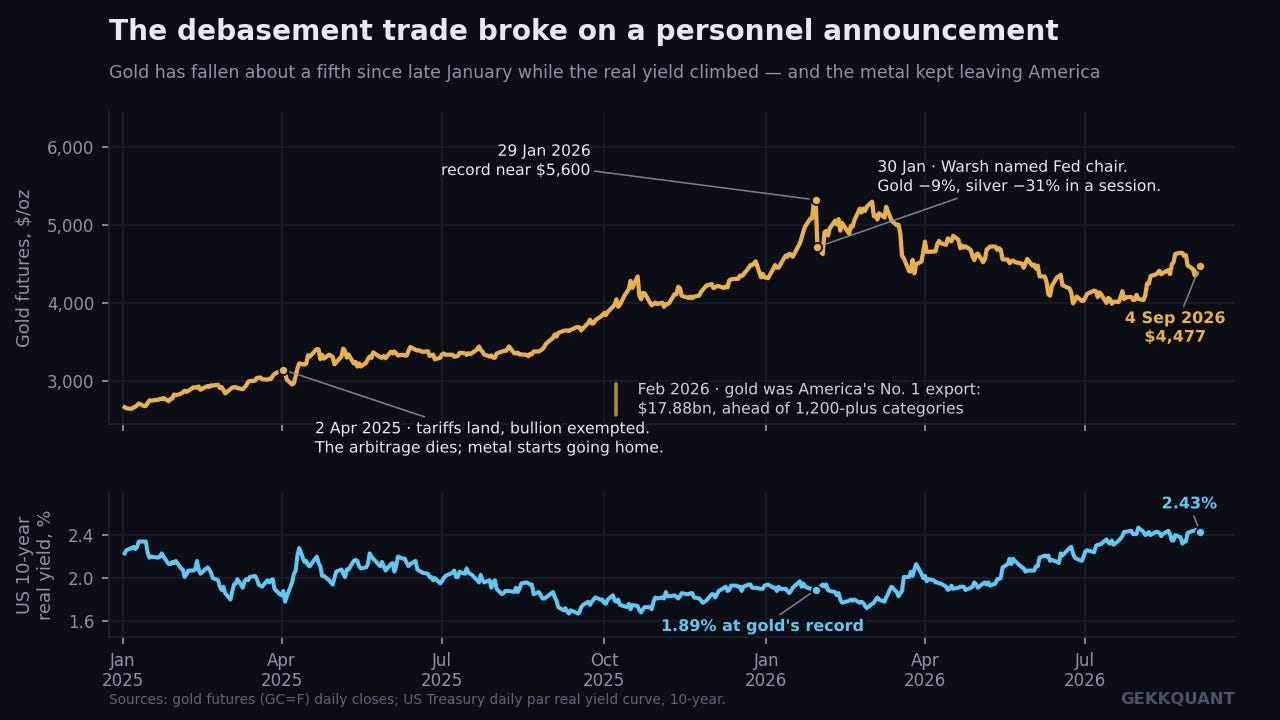
In February, the most valuable thing the United States sold to the rest of the world was not a jet, a chip, a barrel of oil or a bushel of soybeans. It was gold. $17.88 billion of it in a single month, the largest monthly gold export in at least 2 decades of Census records, sitting at the top of a list with more than 1,200 categories on it.
That fact has been doing an enormous amount of narrative work all year. I have now read 4 versions of the same essay in the past 2 weeks: the vaults are emptying, the plumbing is screaming, the world is quietly stepping off the dollar, and the metal knows something the rest of us don't. It's a wonderful story. It has the shape of a thriller — the gold moves at night, and only a few people can hear it.
Here's the problem. Gold futures closed Friday at $4,477, about a fifth below the record set in late January, a little under $5,600. And the metal has been leaving American vaults since the spring of 2025 — first while gold rose 65% into that January record, then while it fell a fifth away from it. Same flow, opposite prices.
Monetary flights don't look like that. Freight does.
The metal is leaving because a tariff never happened.
Late in 2024, bank risk desks ran the obvious stress test on the incoming administration: what if bullion gets tariffed on the way into the country? A short futures position on COMEX is a promise to deliver metal in New York. If the metal you would deliver suddenly costs 10% more to import, that promise gets expensive fast. So the spread between London spot and New York futures — the EFP, normally a boring $10 to $20 of freight, storage and insurance — blew out past $60.
A $60 spread is not a signal. It's an instruction. Swiss refineries flew bars to New York daily. COMEX warehouse stocks went from 17.1 million ounces in November 2024 to 43.3 million by March 2025, a 153% build in 4 months. Roughly 26.5 million ounces of gold crossed an ocean to dodge a tax that did not yet exist.
On 2 April 2025 the tariffs landed, and bullion was explicitly exempted. The next day the EFP collapsed from above $60 back toward $20, and the entire trade lost its reason to live. Switzerland's gold shipments to the United States fell from 103.3 tonnes in March to 12.7 tonnes in April. The flow in the other direction went from 25.5 tonnes to 63.0.
Everything since has been the return leg. The gold "fleeing America" is going home to the vaults it was airlifted out of.
I did chemistry before I did futures, so here is the version that made it obvious to me. Le Chatelier's principle: apply a stress to a system at equilibrium and it shifts to relieve the stress; take the stress away and it shifts back. Nothing about the underlying equilibrium ever changed — only where the metal had to stand while the threat was live. Read the export tables as chemistry and they are unremarkable. Read them as prophecy and you will buy the wrong thing.
That explains the direction of the metal. It does not explain the price, and the price is where the lesson actually is.
On the morning of Friday 30 January, gold was at an all-time high and silver had spent a year going near-vertical. That day, Kevin Warsh was named as the next chair of the Federal Reserve. By the close, gold had fallen more than 9% — $5,395.88 to $4,865.35 — and silver had fallen 31%, from $114.04 to $78.29.
No inflation print. No supply shock. No war, no default, no failed bank. A personnel announcement.
Sit with that, because it is the whole argument. If gold were insurance against monetary disorder, the identity of the next chairman would be a footnote. Instead it was the entire position. That market was not long a hedge against debasement. It was long a bet that policy would stay loose, wearing a hedge's clothes — and it found out the difference in a single afternoon, at the worst available price.
Then came the part that settles it. Gold did not stay broken. It went straight back up, and by 2 March it closed at $5,294 — within 0.5% of its best close ever, with every debasement essay of the year still in circulation and the export data screaming. It got the whole move back.
Look at what was underneath it. Gold set its record with the 10-year real yield at 1.89%. On 27 February that real yield printed its low for the year, 1.72%, and the retest arrived within days. The rally held exactly as long as the real yield did — not a week longer. From there the real yield climbed to 2.47% by the end of July, and gold closed at $3,986 on 16 July, a quarter below its best close. It has ground back to $4,477 since. The real yield finished Friday at 2.43%.
The metal is not tracking the deficit, or the money supply, or the export manifest. It is tracking what you get paid to own a government bond after inflation.
Gold is up about 3.5% on the year. It simply took a route through $5,318 and $3,986 to get there.
I keep a folder of the pieces I disagree with, which is a bad habit that occasionally earns its keep. The autumn 2025 file is thick with essays explaining why gold at $4,000 was only the beginning. None of them mentions a real yield.
So here is my line, because a view without one is content rather than a position. If gold closes back above $4,900 — a little above where it landed on the day it broke — during a stretch in which the 10-year real yield is also rising, then the bid is genuinely independent of rates, the debasement thesis has an engine I cannot see, and I will write that admission right here. My expectation is duller and harder: gold's next real leg needs the real yield to fall, and real yields fall when growth breaks, not when the essays get better.
Why does an index-futures trader care this much about a metal he doesn't trade? Because a great many people hold the debasement hedge and the index at the same time and believe they own 2 different things. They own the same thing twice. Both positions are short real yields, and both get marked against the same number.
Friday made the point without needing a commentator. August payrolls landed at 162,000 against a consensus near 53,000, unemployment held at 4.1%, and the market's read of the 16 September meeting moved further toward a hike. Gold fell. The dollar firmed. The Nasdaq closed lower. The hedge and the thing it was supposed to hedge went down together — the only test that matters, and it failed.
Fed funds sit at 3.50% to 3.75%. At Jackson Hole the new chairman said he stood there "committed to a discipline, not to a decision," which is chairman for: the hike is live. On 16 September we find out how literally he meant it.
The vaults will keep emptying either way. That is a shipping manifest, not a signal. The signal is 2.43% — and it closed the week near the top of its year.
- Gekkquant · My trade signals live on Whop: https://whop.com/gekkquant/